Farm Photos

Monday, February 11, 2013

Chicken Coop Construction #2


It’s been a bumpy road, but I am thrilled to finally be able to post the completion of this coop. If ever someone was as happy about a chicken coop, I doubt it. This was a learning experience, problem solving and ‘making it work’ all the way. It actually helped that as we finished it up someone gave us three red laying hens, so we were forced to finish it and now are able to see how it’s working. 


Chicken Philosophy:

Our chicken philosophy is basically the golden rule; treat your animals’ right and give them healthy food and they will do the same to you. Through taking this part of my own food supply into my own hands and personally overseeing the process, I am eliminating my participation in the industrial food process for this product. Beyond food, chickens are domesticated farm livestock that, when raised traditionally, contribute to a healthy fertile farm. 

I realize that raising chickens isn’t an option for all people. With my backyard flock, I hope to provide four people: two of us here and two of our friends in town, with eggs. We don’t eat meat, but if we did we would still have to purchase chicken somewhere else. I am providing my household with its chicken needs and another household with its eggs needs, everyone with a small flock could do this. We still need sustainable methods of producing meat and eggs for all people. Joel Salatin of Polyface farms in the Shenandoah Valley of Virginia is currently spreading the word about how he does this.

“Our whole culture suffers from an industrial food system that has made every part disconnected from the rest. Smelly and dirty farms are supposed to be in one place, away from people, who snuggle smugly in their cul-de-sacs and have not a clue about the out-of-sight out- of-mind atrocities being committed to their dinner before it arrives in microwaveable, four-color-labeled, plastic packaging… The notion that animals can be raised, processed, packaged, and sold in a model that offends neither our eyes nor noses cannot even register on the average bureaucrat’s radar screen — or, more importantly, on the radar of the average consumer advocacy organization. Besides, all these single-use megalithic structures are good for the gross domestic product. Anything else is illegal.” – Joel Salatin, Everything I Want to do is Illegal.

Polyface farm is a 550 acre meat farm which produces beef, chicken, pork, turkey and rabbit. According to author Michael Pollan and Polyfaces other fans, this is one of American’s most sustainable meat farming operations. Through Salatins’ sustainable biomimicry, nutrient recycling, and animal rotation techniques he produces 25,000 pounds of beef, 50,000 pounds of pork, 12,000 broilers, 800 turkeys, 500 rabbits, and 30,000 dozen eggs annually. He does this without using industrial feeds, fertilizers, pesticides, antibiotics, growth hormones or trucked-in soil. Salatins faming style is catching like wildfire within a community of American farmers who are searching for a way to hold onto their livelihood. We must design our farms to operate post-oil for there to be any hope of them succeeding. 

Reading on Polyface and sustainable Meat Farming:


Raising chickens:

Chickens hatch and become full-grown in one year. Once they are grown, hens will begin to lay eggs given that they have adequate exposure to light each day. After three years, the laying will diminish and eventually the hen will no longer lay. Chicken will live between 8 and 10 years on average. On a typical, small homestead farm, a farmer would keep a rooster along with his hens. Every time the farmer wanted to harvest chickens for meat or replace chickens which had died, he would allow a hen to brood (sit on the eggs) until they hatched. Or, he could take the fertilized eggs to an incubator…either way, new chickens. A hundred years ago, your chickens were your chickens…they gave you eggs and when they got too old, you ate them. Nowadays, there are specific breeds of chicken that farmers raise separately from their laying hens for meat birds. 

Upon learning what we had about raising hens, Andy and I had some choices. Did we want a rooster? If we were truly self-reliant and had no one else to trade with then having a rooster would be essential. But we happen to have two neighbors who both have roosters, and adding another one to the noise of the existing birds may get annoying. Also, because the neighbors have roosters, we could always trade for fertilized eggs from them when we need more chickens. 

Even though there’s no visible different until after a broody hen has sat on an egg and it’s had a chance to develop, there was just something about eating a fertilized egg, rather than an unfertilized egg that grossed me out. It is peace of mind knowing that we’ll never have to crack open a partially developed egg on accident. 

Brrrr! Cold and Rainy!

We discovered how to make pretty art flowers from recycled plastic bottles!


The run door, ready to go on!


The three access doors...

 It's important to be able to have easy access to your coop, so Andy and I decided on three access doors. A main door to clean out the coop bedding, a door to easily access fresh eggs, and a door to access the far-side of the coop which we may turn into a storage area.


We found a piece of wood on the property to serve as the run door handle. Below, a plastic tub we used as a window. When the coop light is on, the sun shines illuminating the painted rays.


Assembling the coop by moonlight! Hens are coming!
The walls are plywood, we framed them in with 2X4's. We had a ton of spray paint left over from a previous project, so we used it to color the entire coop. The bright colors will be fun and attractive for kids and people learning about the farm.


 This is the chicken door, which they will access via a ladder. The coop is placed off the ground to discourage predators and pests from entering.


The roof is corrugated plastic; it allows sunlight to come into the coop even during colder days when they may not want to spend alot of time outside.


The chicken door can be drawn up from outside the coop. This makes it convenient for us to let them out each morning, we don't have to enter the run.


Inside the coop are wood shavings, and in the run we put straw on the ground. The Chickens like to scratch and spread the straw; inside the coop the shavings or chips (which we will produce ourselves with a wood chipper) will absorb the liquid waste and be easy to clean out. This time we purchased the chips from a local farm store and the straw from a neighbor.
 We have bought feeders that the previous owners of the hens gave us, but we made additional recycled feeders from drinking containers. Our laying boxes are temporarily cardboard, they will last long enough for us to build more permanent boxes.


And they arrive! This coop is an upgrade from the small backyard coop they lived in at their previous home.  They are about a year and a half old and once they settle in, they should begin to lay.

We didn't get to choose the breed but these hens were free, these are Rhode Island Reds. We will add to our small flock with additional hens we choose and purchase from local farmers.
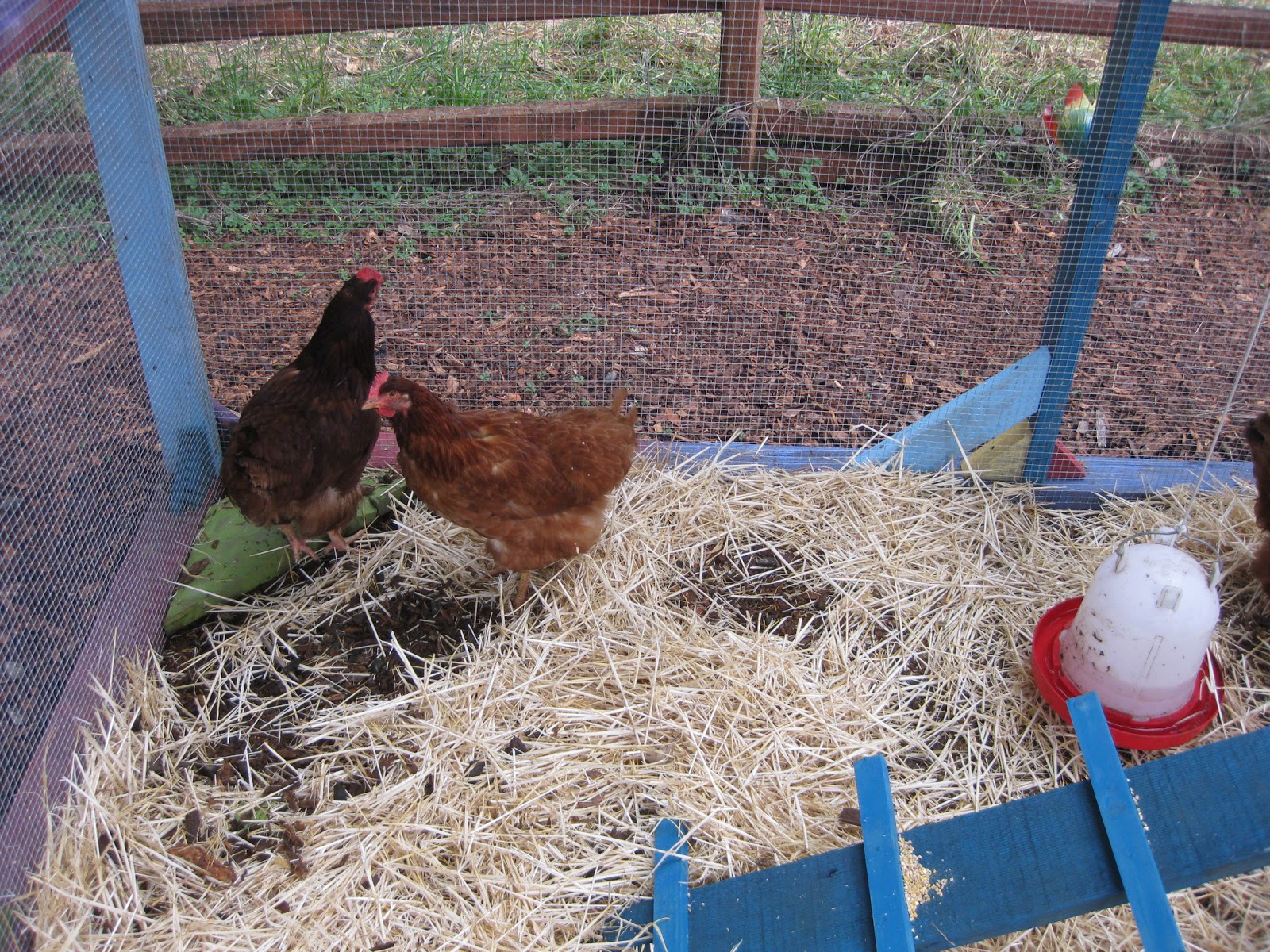

It was exciting to see them using the roosting bar we made.


A Video Featuring Joel Salatin and Polyface Farm.


Sunday, February 10, 2013

Biodynamics


Burying a cows horn in the fall is a common biodynamic practice.
Sometimes at the supermarket or farmers market you come across products that say “Demeter Certified” or “Certified Biodynamic.” Biodynamics is a method of farming coined in the late 19th century by Rudolph Steiner. Steiner was one of those ‘outside the box’ type of people. Not only did he found biodynamic farming, along with some other visionaries Steiner founded the Waldorf Schools, he founded series of natural pharmaceutical companies which distribute natural medicines, he founded the Anthroposophical Society, he also contributed popular works in the areas of science and philosophy including: Truth and Knowledge (1892), The Theory of Knowledge Implicit in Goethe's World-Conception (1886) and Goethe's Conception of the World (1897).

At first glance I wondered, “how did this guy do it all?” It came clearer upon realizing his strong ties to Annie Besant and the Theosophical society. After writing an article about the philosophies behind Goethe’s fairytale, Steiner was invited to speak at the German Theosophical Society and soon after became very involved with them. Later he wrote a book titled Theosophy,

 
“This book, subtitled An Introduction to the Supersensible Knowledge of the World and the Destination of Man, is a good starting point among the hundreds of books written by Rudolf Steiner. He sees a tripartate model of the individual here: body, soul and spirit, cautioning us that these are only approximate terms. In the course of this short two hundred page book we explore higher realities which have eluded the scientific method: planes of seething elemental spirits, zones wandered by reincarnating entities, and more abstract 'places' where Platonic Archetypes dwell. He explains how auras are one modality of these higher existences which we can view in our present form.”


Obviously Steiner was pretty esoteric… trained in the ways of thinking esoterically. So, it follows that biodynamics is a very holistic and esoteric method of farming. The main working idea behind biodynamic gardening is ‘the farm as an organism’ and ‘the organism as an interconnected network of other organisms.’ 

You are a network of organisms; “The number of bacteria living within the body of the average healthy adult human are estimated to outnumber human cells 10 to 1” – Science Daily, June 5th (2008). All of these other life forms colonize within us and they are essential to our well-being. The Earth, if thought of as an individual living being, is actually a network of interconnected organisms and ecosystems of which we are a part. And the garden, all of the insects, microbes, animals and plants are essential to its well-being as a whole.

Biodynamic Farmers follow organic principles: no pesticides, no chemical fertilizers. They use many well-known methods of organic food production like companion planting, cover cropping, legume nitrogen fixation and mulching. Biodynamic farmers take it farther than simply organic:

“Biodynamic farming involves managing a farm utilizing the principles of a living organism. A concise model of a living organism ideal would be a wilderness forest. In such a system there is a high degree of self-sufficiency in all realms of biological survival.  Fertility and feed arise out of the recycling of the organic material the system generates.  Avoidance of pest species is based on biological vigor and its intrinsic biological and genetic diversity. Water is efficiently cycled through the system.

While agriculture takes nature to a state that is one step removed from wilderness, the wisdom of the farmer that guides its course can reflect these ancient principles of sustainability.  The view of the farm organism extends beyond the fence line and includes the tangible and intangible forces that work through it.  Examples include the climate, inherent wildlife of the earth (above and below the ground), the light and warmth from the sun and the more distant astronomical influences.  Biodynamic agriculture attempts to harmonize all of these factors within a holistic, living farm system.  The food that results is very pure and true to its essence and provides deeply penetrating nutrition that is essential to an increasingly unhealthy human population.” –Demeter-USA.org


Similar to Permaculture, these Biodynamic activists are saying that they use the forest as a model for designing the farm. However, I think that biodynamics commands more of a reverence for Nature as a spiritual entity than Permaculture ever attempted to. 

There are some very specific practices associated with Biodynamic farming, and in order to become Biodynamic Certified one must comply with the Demeter Biodynamic® Processing Standard. Demeter being the Greek goddess of agriculture, the very name of the certification reflects the ideologies of biodynamics. 

The Use of Preparations: 


A Biodynamic preparation being stirred.
“The use of the preparations is a requirement of the Farm Standard.  There are nine in all, made from herbs, mineral substances and animal manures, that are utilized in field sprays and compost inoculants applied in minute doses, much like homeopathic remedies are for humans.  Timely applications revitalize the soil and stimulate root growth, enhance the development of microorganisms and humus formation, and aid in photosynthetic activity.”

Where the Fertility Comes From: Must be produced on-site. This practice ensures that farmers aren’t depleting Natural resources but actually contributing to them.

“The Farm Standardinstructs that the foundation of the fertility system, and strategies for disease, insect, and weed control, must originate from the farm itself.  Fertility is generated via the integration of livestock, compost and green manure, nutrient catch crops, and careful crop rotation.  Disease and insect control are addressed through botanical species diversity, predator habitat, balanced crop nutrition, and attention to light penetration and airflow.   Weed control emphasizes prevention, including timing of planting, mulching, and identifying and avoiding the spread of invasive weed species."


In addition, farmers must set aside at least ten percent of their farm acreage as a ‘biodiversity preserve.’ This preserve might be natural wetlands, forest, riparian corridors and intentional insectaries. Now, just growing the food this way is one step,


“The crops resulting from a certified Biodynamic farm are themselves certified (for example Biodynamic tomatoes), but in order to produce a certified processed product  (for example pasta sauce) the product must be produced in accordance with the Demeter Biodynamic® Processing Standard.  There are fourteen different processing standard categories (compared to one for the entire National Organic Program), including wine, cheese, olive oil, dairy and body care.  The Processing Standard is very important because it guarantees an unbroken chain of accountability from the farm to the finished product, and delivers a product that allows for the integrity and purity of the agricultural ingredients to define it.”


The esoteric philosophies of Biodynamics founder, Steiner, ring throughout the practices and methods of the system. Biodynamic farmers have a spiritual connection with their land, their farm, their crops and animals. Each pile of compost is artfully crafted using methods akin to that of homeopathy. Each preparation is prepared with a meditative state of mind, and it is applied at a specific moment in astronomical time. Each crop is planted with respect to the positions and phases of the moon, planets and other astrological bodies in the heavens.  As above so below.


Further Reading:


Petherick, Tom. Biodynamics in Practice: Life on a Community Owned Farm: Impressions of Tablehurst and Plaw Hatch, Sussex, England. Rudolf Steiner Press, 2011.


Wednesday, February 6, 2013

Let's talk about Eggs Ba-by!


As the chicken coop gets final touches and I ready myself to choose the breeds of laying hens that we would like to raise, I thank the universe that I will no longer have to swoon over the isle of egg choices at the supermarket. I can rest assured that my hens are raised humanely, and my eggs are of the utmost freshness and quality. 

Industry poultry farming is an atrocious event; both in production of eggs as well as meat. Whether you are looking at it from an environmental standpoint, an animal welfare perspective or health related concerns industry chicken factories often offer the triple whammy.
Environmentally, high volume chicken sheds produce thousands of tons of toxic waste each year. Much of that flows into bays, rivers, lakes and oceans choking out sea life and ruining aquatic ecosystems. According to Mark Winne,


“In Maryland, the poultry industry went from 90 million chickens in 1960 to 270 million chickens in 2005. As reported in the New York Times, this threefold growth also resulted in a near tripling of chicken manure generated, to 297,000 tons a year, which is largely responsible for the growth of phosphorous and nitrogen levels in the Chesapeake Bay. This pollution caused the number of oystermen who worked the bay to drop from 6,000 a year to fewer than 500. The Heritage Chesapeake Blue Crab population has plummeted by 70 percent.” – Food Rebels, Guerilla Gardeners and Smart Cookin’ Mams Fighting Back in an Age of Industrial Agriculture; page 36.


The Animal welfare concerns are pages long. From debeaking the birds to reduce cannibalism to force molting (starving) them to induce additional laying cycles the industry has succeeded in completely commoditizing these animals with an absolute lack of love or compassion. EON, an environmental activist group from Wesleyan University in Middletown, Connecticut speaks to illuminate the inhumane treatment of poultry livestock in factory farms in an article titled: Factory Egg Farming is bad for the HENS... Check it out here:

It is perhaps the health aspect of it all that pokes at my most ancient sense of self-preservation and probably pushes me the farthest. Yes, I eat organic because I’m selfish, alright? I really don’t want to get cancer, I really want to have babies with all their marbles where they should be. Another quote from Mark Winnes’ Food Rebels,


“As the toll mounts from factory livestock production, we see the risk to the public health change from things we can see, smell, or taste (our senses having always been our best defense against danger) to things that are not easily detectable, things that couldn’t even be imagined many years ago. Human resistance to antibiotics is one such threat. A particular strain of bacteria that, according the Journal of the American Medical Association, is responsible for 19,000 deaths a year in the United States – that’s more than AIDS kills—is winning the war against antibiotics. The widespread non-therapeutic use of antibiotics is suspect as culprit in the skyrocketing number of antibiotic resistance cases in humans.” Page 36-37.


This is a bad cycle. In attempting to raise animals as industrial products we shove a lot of them into tight spaces together. When animals are kept like this, the risk of infection is really high and should infection occur it spreads rampantly. So, antibiotics are given to factory farmed animals (including laying hens) as a preventative measure. Unfortunately, humans are also consuming the drugs in the meat, eggs and milk of these animals. 


“The American Public Health Association called for a moratorium on the development of all future CAFO’s (Confined Animal Feeding Operations) until a series of environmental, health and social issues could be scientifically addressed and resolved. In 2006, the Pew Charitable Trusts convened a commission on industrial farm animals production. This commission issued a report in 2008 recommending new laws regulating pollution from industrial farms, a phasing-out of CAFO’s that restrict ‘natural movement and normal behavior,’ a ban on hormones to promote animal growth, and an application of antitrust laws to encourage more competition and less concentration in the livestock industry.” Mark Winne, Food Rebels…; page 37.


It’s not only antibiotics to be concerned with either, hormones were linked to premature puberty in young Puerto Rican girls consuming chickens with high levels of estradiol,


“An alarming incidence of premature sexual development has been reported in Puerto Rico during the last 7 years. A significant increment of premature thelarche, premature pubarche, prepubertal breast enlargement in boys, and precocious pseudopuberty in girls has been observed throughout the island. Several food specimens analyzed by chromatography and cytosol receptor assay revealed significant levels of estradiol equivalent in some meat samples. We suspect that the early sexual development is caused by exogenous estrogen contamination in the food ingested by the children and by their mothers.” – Sáenz de Rodriguez, Carmen A., Alfred M. Bongiovanni, and Lillian Conde de Borrego. An epidemic of precocious development in Puerto Rican children. "The Journal of pediatrics" 107.3 (1985): 393-396.


While scientists still aren’t entirely conclusive, another paper published in 2011 suggests a link between exposure to environmental estrogens and autoimmune diseases.


“The prevalence of autoimmune diseases has significantly increased over the recent years. It has been proposed that this epidemiological evidence could be in part attributable to environmental estrogens, compounds that display estrogen-like activity and are ubiquitously present in the environment.
Environmental estrogens can be found in a wide variety of foods: phytoestrogens occur in plants such as clover and soy, while mycoestrogens are food contaminants produced by fungi. Meat, eggs and dairy products from animals given exogenous hormones contain relatively high concentration of estrogens. Among xenoestrogens, industrial estrogens are synthetic chemicals produced for specific purposes (pesticides, plastics, surfactants and detergents) while metalloestrogens are found in heavy metals. Estrogens can be also administered through medications (contraceptive pill, hormone replacement therapy, genistein, cimetidine, creams).”
Chighizola, Cecilia, and Pier Luigi Meroni. The role of environmental estrogens and autoimmunity. "Autoimmunity reviews" (2011).


I’m convinced that I don’t know what’s in factory eggs and that I don’t like the way the animals are treated. I’m also convinced that raising chickens is enjoyable and rewarding. Nothing beats local, farm-fresh chickens. But, if you can’t raise chickens and the supermarket is all you’ve got…what should you buy? Whether you are shopping eggs or meat, there’s your standard Grade A, AA or, you can choose from the “humane” options: Cage Free, Free Range, Vegetarian Fed, All Natural, Organic…the problem is that companies aren’t exactly clear about what these labels mean…and often they don’t mean everything you think they do. 

Grade AA Laying Hens in a Factory Farm
USDA Grades: The grades mean little when it comes to the issues we’ve been talking about. The differences between Grade AA, Grade A and Grade B are aesthetic; shell thickness and smoothness, egg size ect. This is what the USDA concerns itself with in our present state of food crisis:
 For Grade AA - “The shell must be clean, unbroken, and practically normal. The air cell must not exceed 1/8 inch in depth, may show unlimited movement, and may be free or bubbly. The white must be clear and firm so that the yolk is only slightly defined when the egg is twirled before the
 candling light. The yolk must be practically free from apparent defects.”


Cage-Free Farming Operation - NY Times
Cage Free: Well, you’ve graduated from stacked chicken cages to chicken warehouses. Though there may be no bars, these chickens still have no outdoor access and are packed tightly in high volumes. This label makes no promises regarding antibiotic or hormone treatment, type of feed, or other animal welfare issues such as debeaking, forced molting ect.

Free Range: The label free range actually means that these hens get access to the outdoors at some point during their lives. However, most of the time they are in warehouses, as Michael Pollan puts it in The Omnivore’s Dilemma:
Free-Range Farming Operation - SlowLife.co.uk
"Since the food and water remain inside the shed, and since the little doors remain shut until the birds are at least five weeks old and well settled into their habits, the chickens apparently see no reason to venture into what must seem for them an unfamiliar and terrifying world."
Again, free range makes no promises regarding drug treatments or specific worrisome farming practices.

Vegetarian Fed: I had to stop and think about this one…besides insects, aren’t all chickens supposed to be herbivores? The phrase ‘supposed to be’ doesn’t necessarily exist in the world of reduction science. In fact, many factory farms throw meat by-product into their chicken feed. Are you sitting down?

“Same Species Meat, Diseased Animals, and Feathers, Hair, Skin, and Blood

The advent of "mad cow" disease (also known as bovine spongiform encephalopathy or BSE) raised international concern about the safety of feeding rendered cattle to cattle. Since the discovery of mad cow disease in the United States, the federal government has taken some action to restrict the parts of cattle that can be fed back to cattle. However, most animals are still allowed to eat meat from their own species. Pig carcasses can be rendered and fed back to pigs, chicken carcasses can be rendered and fed back to chickens, and turkey carcasses can be rendered and fed back to turkeys. Even cattle can still be fed cow blood and some other cow parts. Under current law, pigs, chickens, and turkeys that have been fed rendered cattle can be rendered and fed back to cattle—a loophole that may allow mad cow agents to infect healthy cattle. Animal feed legally can contain rendered road kill, dead horses, and euthanized cats and dogs. Rendered feathers, hair, skin, hooves, blood, and intestines can also be found in feed, often under catch-all categories like "animal protein products."”

Sapkota, A.R., L.Y. Lefferts, S. McKenzie, and P. Walker. 2007. What do we feed to food-production animals?; Union of Concerned Scientists.

While I’d take veg fed over Grade AA any day, there’s still no mention of the drugs, handling practices, ecological concerns, or the other treatments. 

Organic: According to the USDA website, “The USDA organic seal verifies that producers met animal health and welfare standards, did not use antibiotics or growth hormones, used 100% organic feed, and provided animals with access to the outdoors.” After some digging, I was able to find out that organic feed includes all organically grown agricultural product (non-GMO, vegetarian grass and grain, no animal by-products). Additionally, 30 percent of the feed must be non-dry matter meaning that it is freshly grazed (or pecked) from a pasture. You can see the full USDA requirements for organic livestock here:


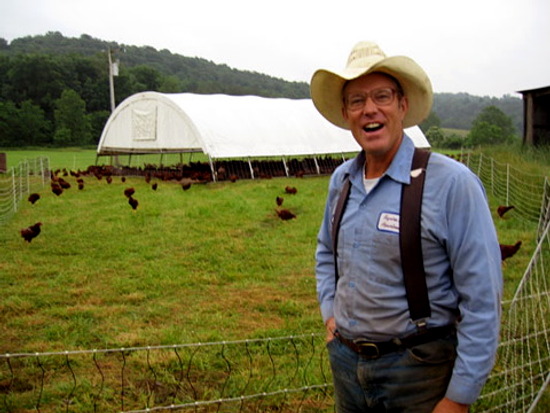
Joel Salatin of Polyface Farm - Organic Meat Farmer, author, and rock-star of Modern Sustainable Meat Farming.
Ecologically there are still issues to work out with what many activists call “industrial organic,” or operations which produce organic product but are as reliant upon fossil fuels and pollute comparably with factory farms. There are many 'organic' farming operations that continue to use industrial top-down business practices and therefore are simply capitalizing on a trend. Joel Salatins operation, featured in the photo above, is not one of those industrial organic farms. In fact his meat-farming techniques have caught like wildfire among organic producers in recent years.

This is why buying eggs from your local farm is the best bet…even if they aren’t certified organic it is likely that they are raising their chickens ‘traditionally’ and without trying, they are meeting organic standards. Always just ask the farmer.
Organic makes promises on several levels, though not cheap. Think about what you are purchasing; ethical peace of mind and health peace of mind.


Sources and Additional Reading: