Farm Photos

Wednesday, January 29, 2014

Soulstice Gardens Poorganics


I’ve been on many sides of the food argument, from apathetic to radical and beyond. I'll admit it, the following words have come out of my mouth: “I don’t care about organic, I’ll eat Western Family all day long!” 

Given, that was a long time ago. When I said that, I was coming from a perspective where it seemed like only fancy people bought organic stuff. I couldn’t afford it, and I’d eaten the so-called “regular” food my whole life already. Why spend more on it? I didn’t know why some people made it a big deal.


Over time I learned more about the dangers of eating pesticide and herbicide residues and the ecological consequences of continuing to farm this way, and I came into a new perspective. First of all, it wasn’t just all about me. It actually made me feel selfish not to buy organic food when I could, because who was I to deny the Earth respect? I am not the type to care more about myself than the Earth, I hug trees and s***t. I don't want animals or people suffering and I don't want to turn a blind eye to it all. This was one choice I had control over, I should make the right one.

These farms are scenes from nightmares, and the folks in charge of them are cashing in on the glory of being the ‘good old American farmer’. But, they do an injustice to the homesteaders and turn of the century farmers who grew this country. The consequences of industrial agriculture have caused thousands of direct deaths, it is the world’s top industry for slave trade and labor…yes, today. The number of slaves currently stuck in the agricultural system is higher than the number of slaves on the planet at the start of the civil war. This business is the business of slavery and exploitation, it represents the worst of human character. Here we are, able to change things in a first world country, and I’ve got the nerve to say something like “I’ll eat western family all day long?” That makes me want to vomit now.


Then people started getting sick as we all grew older. Gall bladders, eye problems, allergies, cancer, and diabetes…it started becoming ever clearer that no one should be denied healthy food = medicine = health. It is a basic human right like clean water, shelter from the weather, and freedom. In a couple of years of study, I flipped my role in this producer/ consumer game.  I became the crazy hippie chick who thinks everyone is going to die unless they switch to 100% organic!
But, on that other extreme end I wasn’t getting a good response from people. I was overly passionate, came off a little crazy, and tended to scare more people than sway them. As I preached organic, I was also a poor student who already spent ½ her (very small) income and $200 worth of food stamps monthly on food…If I wanted to commit to eating all organic it meant eating nothing but rice, beans, and pickled cabbage. Not that it wasn’t healthy, but it certainly wasn’t the rainbow, flavorful, Instagram-worthy, eclectic diet that I dreamed about…and it wasn’t going to convince anyone else to eat this way.


So, how could I tell people to go organic, achieve the flavorful diet I wanted, and also sympathize with being unable to afford it? The answer was to grow it myself. I am committed to having the best of the best food at the price of my own sweat, blood, and tears and no one else’s. And, I decided that since it was going to take a lot of my time to do this, I should probably make it a job and grow enough to share with those around me. So, Soulstice Gardens is just this, a homestead style farm where I am trying to get the most flavorful and nutrient-packed diet I can from the land herein. That which we cannot produce we purchase or trade for after all, ‘self-sufficiency’ is a misleading phrase that dooms many to drudgery and self-imposed poverty. Through growing organic produce which I can sell, I will be able to purchase the additional organic products we would otherwise be unable to afford…all the while keeping on that organic train.

Looking at this from the side of producer, it’s a funny situation. Farmers, gardeners, and people who are familiar with the food system want to know exactly how all of their food is grown. Now I have conversations about whether residue from conventional produce will survive decomposition and show up in your finished compost, a much better topic than whether or not RoundUp is safe.  They want to know if we are certified, what our chickens eat, where our water comes from, what our soil tests look like, what temperature the compost heats to, how we control pests and disease, etcetera. It started to become overwhelming in the other direction; too much concern over possible contamination from “the big bad industrial world.” A better place to be than among the shelves of grocery store poison, but how to become an organic producer without having to wade through endless concerns of ‘questionable practices’, ‘knowledge battles over who knows more sustainable techniques or certifications’? I feel that I have a genuine commitment to treating the Earth, and my animals ethically. No chemical spray or fertilizer ever touches my plants or soil. Now, that being said, I feel absolutely no need to seek out inspection or certification, especially from the very institutions who have failed to protect our food system already. This is when we came up with “Poorganics” as a term for what we might describe as: organic, for the real person. I know that it's been out in the ether and there have been others' who use it with similar meaning, this is what it means to me.

Poorganics applies to both the consumer and the producer, and all types of enthusiasts of organic living. It is a philosophy that represents a dedication to knowledge, integrity, and information, while also recognizing that we live in a world where contaminates are everywhere. The best we can all do is minimize our exposure and work toward a life that is healthier. Poorganics obviously speaks to the fact that most of us don’t earn an income worthy of supporting an all organic lifestyle, but we can learn to buy organic when we can. We can learn about which products contain the highest amounts of residues and choose organic options for those things while saving money by purchasing other items conventionally. In produce, the 12 vegetables and fruits that test the highest for pesticide residue after harvest are called the ‘dirty dozen’, and it’s becoming popular now for restaurants to shop organically for the dirty dozen yet conventionally for others, such as the ‘clean fifteen’. 

As consumers, we can research the issues that affect us most: animal treatment, soil degradation, corporate greenwashing, or whatever you care about. We can choose to avoid products that directly support these practices. One of the first real commitments I made was to go organic for my dairy and eggs because I was concerned about the treatment of animals and the bioaccumulation of toxins within them. Through raising a few chickens, I am able to save money on eggs and purchase organic dairy products.

From the perspective of the producer, Poorganic is how we like to describe our produce to buyers. Certification is something for large farms, farms whose practices are industrial enough to be of concern. We grow food like the pioneers grew it because we like to eat good, fresh, unsprayed, nutritionally dense flora. Like real American farmers, we protect the land we grow it on, because it must serve us for generations to come. Poorganics, from any perspective, is about getting real. I grow tired of hearing people snuff their noses, or laugh, at the word ‘organic’ because it has become too commercialized and too stigmatized. It’s not about who has the best brand at the dinner party, it’s about realizing how industrial farming treats the ecology of our planet. It's about going inside yourself and deciding where you stand on this issue and what you want to eatNo one has to ask the waiter whether the parsley in the chutney on their fancy, wild caught salmon is organic. Or, be the guy to request the name, hometown, and date of birth of his roasted chicken. However, we should be subtly aware of what is really on our plate, what it went through to get there, and what it’s going to do upon entering our bodies.


 I don’t waste my time counting calories, and I’m not bitter enough to refuse to eat the grilled American cheese sandwich at the neighborhood picnic. I am idealistic enough to take action in my own life, to grow fresh vegetables and share them, and to offer to cook for the next picnic. 

Thursday, December 19, 2013

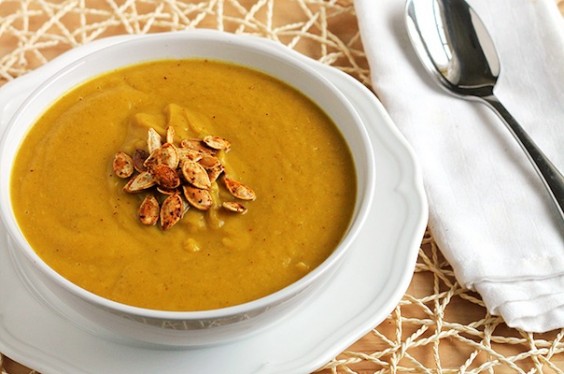
Winter Soup


In our first year here we had a kitchen garden, and grew so many veggies during the summer that we couldn't possibly eat them all. However, we didn't have as much luck in our winter crops. Our autumn brassicas became an early winter snack for deer and rabbits after a tree fell taking out part of the fence. Our root veggies were sparing, and the peacocks made work of our winter greens. Needless to say, in late December here we are with almost no fresh vegetables. There is one crop, though, that is the king of self storage and will warm any cold winter day. Squash; and we've got plenty of them...from pumpkins to butternut to warty yellow squash to acorn. Any squash you've got will do, and will impress your foodie friends as you go from garden to bowl. They've been sitting on my dining table since October, when they were nice for Halloween, and through Thanksgiving. I grabbed one now and then for a jack-o-lantern or a thanksgiving pie...but other than that they served as decor.

Now, as I look around the kitchen for something to cook and realize that we're getting down to extreme basics, the pumpkins on the table begin to take on a new look: lunch. I chose a small, sweet Sugar Baby pumpkin, but any pumpkin or squash will make a good soup.

Cut it open and remove seeds and stringy material. Set seeds aside for roasting or re-planting if they are organic! Get the meat separated from the rind, you can peel it or scoop it out if you want to retain the pumpkin to use as a bowl. I usually cut it into small pieces and then peel it with a knife, because I find scooping exhausting. If you hate trying to get the rind off the meat, then cut the whole thing in half and put in uncovered face up on a cookie sheet. Bake until you can slide a knife through the meat easily, and the rind will just basically fall off.

I don't bother with baking, or using a steamer...I like to do it all in one pot. Fill about 1/4 of the pot with water, and then add enough pumpkin to fill it up to the lid. If it seems like too much water pour some out, or you can evaporate it out later. Place lid on pot and bring to a boil. Simmer, covered, until you can slide a butter knife through the pumpkin chunks (or if you already baked it then simmer until you can mash). Mash the pumpkin into oblivion; some people use a processor but I don't find in necessary, chunks are good. What you want is a generally smooth, soupy texture with some lumps and chunks.

Add one can of coconut milk, and a tablespoon of curry powder. Taste, and add curry powder, salt and pepper to your preference. Now, if the soup still feels watery let it simmer, uncovered, until it thickens. If it is too thick, add water! SO EASY! and very good with homemade bread.


Don't forget to roast your seeds! They make a good topping, or just a snack. You can use just about any seasoning you like: garlic powder, cayenne, cajun, curry, parmesan, or just salt and pepper...experiment! Just toss them with some oil and seasoning, spread them on a cookie sheet and roast in a 300 degree oven for about 45 minutes or until they look brown and crispy.


Wednesday, December 11, 2013

Why Free Spirits and Flower Children Always Start the Revolution!


I won’t reiterate all of the things we already know and mostly agree upon. Corporations rule the world both first and third, with government puppets. They have imposed a culture of capitalism and in turn produced class warfare. The industrial drive to progress and produce has reaped irrevocable havoc upon our planet; Earth. 

However distant the insane monarchies of middle age Europe seem, we are living in one. Despite illusions of evolution and democratic progress…we live under the tyranny of a handful of wealthy people. These elite have no connection to the working class, or the state of our cities, our oceans, our water, our families. They live in bubbles of Elysium-like purity. 

We are even getting to a point where most of the people agree that the problems facing our economy and our planet are hand-in-hand. To get to this point, however, we must learn to see through the corporate veil.  As Pulitzer Prize winning author Chris Hedges states in a recent speech to students: “The corporate state rather feeds the thirst for illusion happiness and hope, it peddles the fantasy of endless material progress, it insists (and this is globalization) that our voyage is unalterable, decreed by natural law. It is part of the march of human progress and those who challenge this myth are heretics.”  This entitlement to progression is a curse, it is a mental illness which no person who values humility would ever justify. I say no. Human ‘progress’ is a myth; a linear path of existence is a model far too outdated and desperate to be replaced. 

It falls to those who dare to be idealistic to envision parts of the future. It falls to those who care enough to seek an alternative; those who refuse to be a part of the destruction. That is bravery beyond measure. And, because today the problems are global, it is further requiring an element of universal care within all those seeking to change the system. And, in the face of such an all-consuming, greed driven, ruling class what better tool for change than love and peace? It is something industry does not understand. It does not understand it because it was made by people who fear the unseen, people who fear faith. Sounds strange…but faith is really the opposite of fear, it is a form of love. Not in any religious sense of that word, faith, but in the sense of taking that giant leap of faith in the face of fear. The hero of our human story takes that leap of faith because of love. Love for her people, her homeland, love for herself, her way of life, her culture, and her conviction of what is True.  At a risk of slightly over simplifying…We, the collective human that is our entire species, is now standing on that precipice. 
 

It’s hilarious the juxtaposition of our culture. On one hand we have this monostory about a hero who defies all fear and impossibility in the name of love and goodness. He is altruistic and just and caring, the type of person all our politicians try to portray with their swagger. Yet, everything about our economy and our system shows a complete lack of that type of faith or love. There isn’t a C.E.O. on the planet who would take a financial leap of faith for the third world; and you’d be hard pressed to find a president who’d do that. It’s bad business to take such risks, and those who do, or even suggest something like giving stuff away are ridiculed out of the business. 


Within this picture money represents our fear of faith. People hoard money because they fear that the Earth, their community, the government, will not provide what they need. It’s a safety net that seems insane to dismantle. When locked into a cycle of fear this deep, the only thing that can really bring people out is love. And, it HAS to come from both sides. People who have found a new way of life must learn to love people who ridicule them for it; they even have to start giving stuff away to these non-believers in an act of faith. Those who don’t believe in alternative forms of living have a responsibility to find love for people who are living alternatively and talking about it. Part of love is patience and an open ear; it is an initial act of faith to dare to dream. 

Even popular culture reflects our disdain for those who ‘care’ in characters like Lisa Simpson who can’t catch a break, or through unfeeling characters like Peter Griffin of Family Guy who is quite obviously a sociopath. We have to bring back love in a big way and make it cool again to care. This is why flower children and free spirits always start the revolution. They aren’t afraid to have faith in each other, or to love without condition. What does the hero always learn once they leap? That the fear was an illusion to begin with and all you really have to do is take one tiny step to find out that there’s a bridge. 

It is in people that we must place our faith, our neighbors, our schools, our forests, our farmers, our artisans, our homes, our families, our soils. You can love a corporation to death but it cannot love you back, it is a false entity created by the fearful to do nothing but protect its money, it is a dragon. Love for the people at the head of these entities, or those who make up the bodies of them is good. These people are slaves to their fear, working ever harder to support this dragon of consumption and illusory progress. Those who have detached from the fear entity can show others, through their commitment to undying and unconditional love, where to cross that bridge. Your time is over “dog-eat-dog” culture, it is the dawning of the Age of Aquarius when peace will guide the planets and love will steer the stars. 


Monday, September 16, 2013

Vegan Zucchini Bread

Vegan Zucchini Bread


You know what I love about this recipe? (No, I can't just write a recipe. As soon as my fingers touch the keyboard, it feels so good.) I love that if you make it exactly as it is written here, it requires you to use three of my favorite items in the kitchen.


1) Apple Cider Vinegar - you should have one bottle in your pantry and one bottle in your medicine cabinet. This is a miracle substance. When eaten, this acid has an alkalizing effect on body ph, (I know, sounds confusing but acids have the opposite effect in the gut) so if you're trying to stay alkaline then add this one to your daily diet. In this recipe, we're using it to replace buttermilk and in fact it's universal. One teaspoon ACV to one cup water replaces one cup of buttermilk. Go Vegans!


2) Coconut Oil - A wonderful, non-hydrogenated saturated fat! Don't demonize saturated fat, it's trans-fats that you want to avoid. Coconut oil gives the body a boost of monolaurin, an indispensable immune system soldier. This rich oil is a solid at room temperature, and makes a wonderful vegan butter replacement. The flavor is relatively strong, heating calms it, but I prefer coconut oil for sweet recipes or savory recipes in which coconut would be a welcomed guest.

3) Flax Meal - Flax has gotten alot of attention lately for it's omega fatty acid content, and evidence linking consuming flax seed to lowered risks of heart disease, diabetes, and cancer. Flax meal is my favorite way to have it in the kitchen because it's just so versatile. Throw it into pancakes, breads, sauces, pizza, smoothies...whatever! Also, in baking, Flax meal fulfills the binding role that normally we would use eggs for. 

And, voila! You've just replaced three animal based, potentially artery clogging ingredients: Buttermilk, Butter, and Eggs...with three ingredients known to improve heart health and body vitality. I'm not one to normally preach against butter, eggs or buttermilk and if you have a local, organic source of these foods then please, eat them! But, I do have vegan friends and I like to be able to feed them too! Plus, any excuse to stick all those great fats together in a recipe.

Finally, the bread: Makes 2 loaves

2 Cups grated Zucchini (there it is!)
1/4 Cup coconut oil (melted)
1/4 Cup oil (I use grapeseed; see below!)
1 Cup Sugar
2 Cups water and 2 tsp. Apple Cider Vinegar (ACV)
2-3 Tbsp. Flax Meal
1 tsp. Salt
2 tsp. Baking Soda
3 1/2 Cups Bread Flour
2 Tbsp. Cinnamon (or to taste)

Coat two loaf pans with coconut oil. If you've got an apron on that can take a bit of grease, don't wash your hands after touching the oil! (Please, do wash them prior to starting recipe) Coconut oil is one of the best for chapped skin, hands, feet, and face. Let your hands work with the ingredients and soak in some healing fatty acids at the same time. 

Melt coconut oil and combine with grapeseed oil in mixing bowl. Blend into oil: sugar and water with ACV. In separate bowl combine flour, salt, baking soda, and flax meal. Add dry mixture to wet mixture in small increments while constantly stirring. Last, stir in zucchini. Batter should be lumpy, but does not form stiff peaks and settles into pan. 

Baking: I bake mine in a bread maker for about 1 1/2 hours at 300 degrees. I'd give it about 1 hour in a 350 degree oven. Set your timer for 40 minutes and check it. When the top looks done, let it bake for another 10 minutes. Insert wooden dowel to be sure it's done before pulling it out. (You've got to feel the bread, be the bread, lol)


Quick note on grapeseed oil. 
I will not advise people to use vegetable oil. The truth of the matter is that most stuff titled veggie oil out there is genetically modified. Stay away from generic vegetable oil, canola oil, and soybean oil that isn't organic. Grapeseed has not yet been defiled by the mutilating hands of Monsanto, and is still a safe, available, and affordable cooking oil. It doesn't have as strong of flavor as olive oil, and performs wonderfully in a bread or a frying pan. 


Sunday, September 15, 2013

Boca Bad News


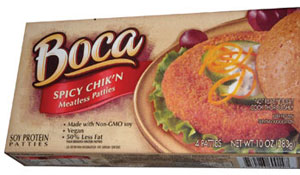
Recently, a friend introduced us to Boca vegan chicken patties. I admit, I fell for the charming convenience and fast food reminiscent taste for quite a while before looking beyond the box. In the back of my mind, because I automatically pick food apart and occasionally just suppress it so I can enjoy something, I knew these were oh so wrong. But I bought them anyway. Finally, after my stomach made it difficult to ignore by reacting strangely to this chicken-like-substance, I did a quick scan with my Buycott app.

Sure enough, it immediately advised me not to purchase. I should have known (I knew); anything that says "soy" in the ingredients and does not have a clear "non-GMO" label is genetically modified. Turns out Boca, the nations number one vegan burger, is chalked full of genetically modified soy. I already avoid soy most of the week, and I know that anything which comes in frozen boxes is too processed to be healthy. Boca is a child company of Kraft Global, possibly the worlds largest producers of cheap, unhealthy food-like products. They donated $2 million dollars, according to the Organic Consumers Association, to campaign against GMO labeling in California (Prop 37).

 
Some suggests switching to Amy's patties, and this is a great idea. Amy's is a good company, widely available, they make quality convenience food. In fact I sat next to an Amy's representative at a conference last year and we had a blast whispering insults at the pro-GMO speaker on-stage. But, darn them, they do not yet have a chicken-ish pattie.

Amy's vegan, non-gmo, soy-based burger pattie

Wait! I never let my smart phone do all my thinking for me. So, I decided to pay Boca a little web visit and poke around. Turns out, they make GMO-Free versions of both the original vegan burger AND the chicken burger. Not that your local Walmart or Safeway would pick them up, but you could ask. They are packaged with a 'natural' brown box in contrast to Boca's typical red visual assault.


Now, here's a solution. However, I have only seen this brand in a few stores and they may not be as easily found. Check your local co-op or health food store. They're called Quorn! I must tell you that I have yet to actually try one of these, but I absolutely love the idea behind this food. These are Soy-Free and GMO-Free (according to a F.A.Q. on their website they use no GM ingredients). These are a mycoprotien, YAY! Like tempeh, it is a mycelium colonizing a grain, in this case wheat mostly. If that scares you than just don't think about it. Mycoprotiens are delicious and a great, safe, non-animal, non-soy, protein source that could become a food of the future. because fermentation occurs during the growth of these mycoprotiens, the food is alive with enzymes and probiotics that aid in digestion. I have thought about trying to create my own chik'n patty using tempeh that is breaded, so these guys beat me to it.

So, what does it come down to? All soy-based products that do not directly say "non-gmo" or "organic" are most likely genetically modified, including your favorite vegetarian or vegan options like Boca. If you're worried about companies like Kraft Global (I know I am) than I wouldn't purchase Boca at all. If you just can't live without those spicy chik'n burgers, then order the non-gmo version online or ask your grocer to carry them. If you feel strongly about not eating genetically modified ingredients, supporting companies of questionable ethics, if you still don't have time to perfect a chik'n recipe, and have the opportunity to purchase Quorn, I would suggest doing that! I'll have to add to this post after I try this new-to-me brand and/or perfect my own tempeh based chik'n patty which I can freeze myself.


Happy Healthy Eating!
Michaelyn


Thursday, September 12, 2013

From Student to Practice

Hello all, short post just explaining the revamping of our blog. This blog was originally written as a project for the Evergreen State College during an independent contract I had as a student. Now, I have graduated and I am gardening full time. I love connecting with the world and sharing our progress, so I would like to continue to blog as I learn to make this senior project into a business. So, what was Onalaska Honalee has now become the official farm blog of Soulstice Gardens. Don't worry, all of my research into Permaculture, Hugelkulture, Biodynamics, and agriculture is still here in the older blog posts.

Now, I will include all of our current and future farm activities, recipes, tips on making a homestead more sustainable, current news on small organic farming, and exploration into various 'green' products. Don't forget to check out the new recipe section: "Food: From the organic obsessed, vegetarian, meat and potatoes raised, bargain hunting girl." I will be adding recipes more frequently now that we're back in the swing.

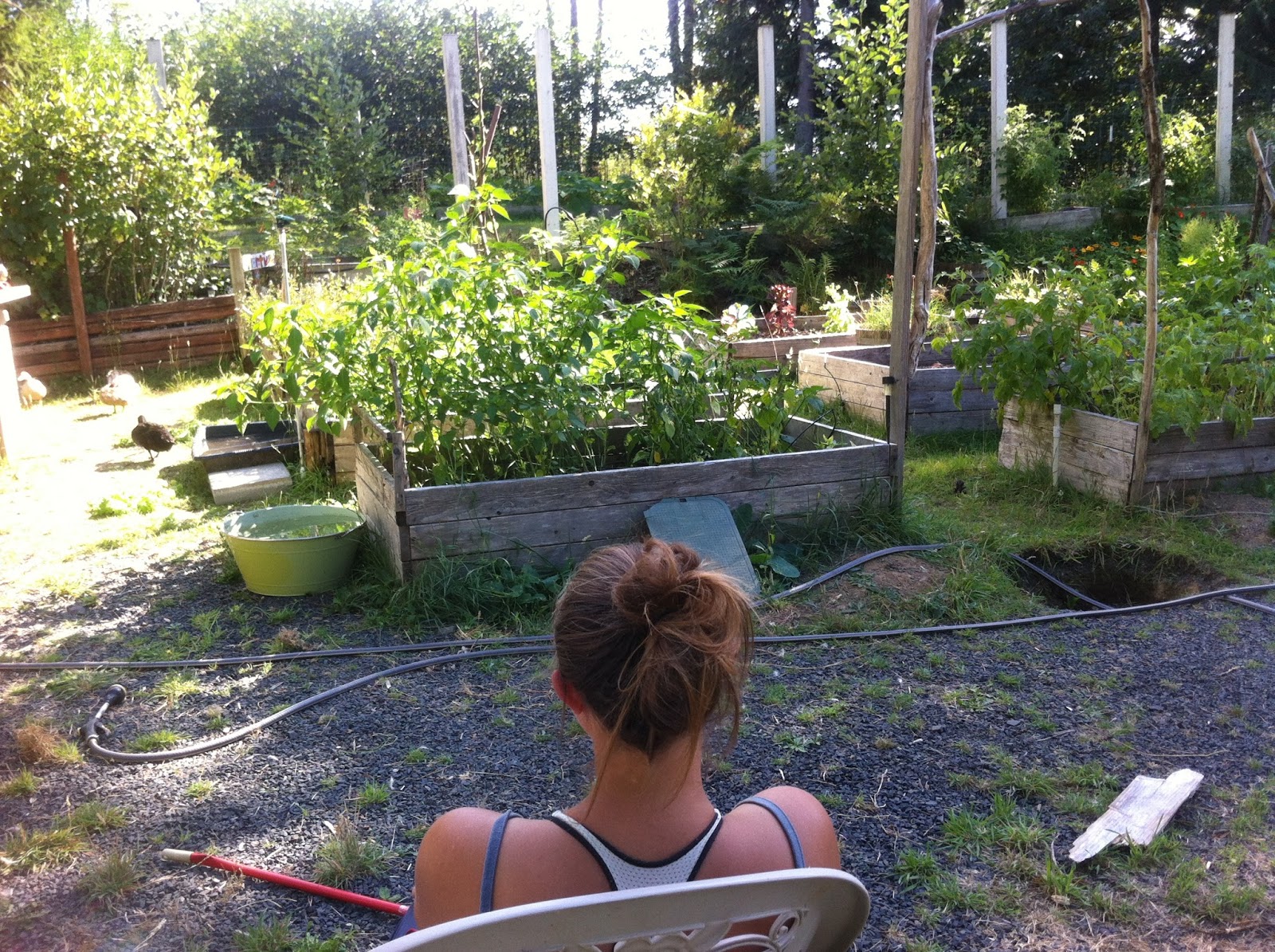
A small farm update: We had an amazingly productive first year here in the kitchen garden at Soulstice Gardens. Next year we are planning to expand to include a market garden, a fungi forest, and a large herb garden. So subscribe to the blog and connect with us on Facebook to get posts:
https://www.facebook.com/soulsticegardens


Sweet purple grape vines.

Lemon Cucumbers, we also had Armenians and Straight Eights.

Zucchini getting a bit too big....

Green Pumpkin.

Whew, long day weeding.


Yogi, the blog dog!


Some Chooks, in their field.


Mmm lunch outdoors.


Slugs be gone! Our ducks are an essential working force in the garden and they do a wonderful job.


Tuesday, September 10, 2013

Vegan Tempeh Chili


When it comes to food, I pinch pennies into diamonds. And, I don’t sacrifice when it comes to health, animal welfare, human rights and earth justice. Food is my life; and every day I learn about growing, cooking, producing, processing, or storing food. I take products on the market and break them down to get to the bottom of what is really in a can of tomatoes, and also explore inexpensive and widely available alternatives. Stay tuned to this page for recipes, favorite products, and food secrets....


Vegan Tempeh Chili: (feeds 2 very hungry people and 4 for afternoon lunch)

1 Onion
1 Bell Pepper (your choice of color)
A handful of chopped jalepenos...how hot do you want it?
2 cloves of garlic
two cups diced tomatoes (or two cans diced tomatoes)
1 can sweet corn (or two cobs worth)
1 package organic tempeh, diced
1 can organic kidney beans
1 can organic garbanzo beans
1 tbps Olive Oil
 1 bay leaf
oregano
cumin
chili powder
garlic powder
salt

in a soup pot; saute onion, bell peppers, garlic, and jalepeno's in cooking oil. When they begin to sweat add Tempeh and let simmer another 5 minutes or so. Just before onions are fully caramelized, add tomatoes, corn, your bay leaf, and a pinch or two of salt. Let that cook for about 7-10 minutes on medium heat, stirring frequently. Add spices to taste or smell, using the garlic powder as a supplement for more garlic flavor.
Add kidney beans and garbonzo beans, not fully draining each can but pouring off about 1/2 of the liquid. Let your chili simmer from 20 minutes to all day if you want. Add salt, pepper and additional spices to taste.


Tempeh: this is a protein packed, grain derived protein source available in some grocery stores in the refrigerated section next to tofu, or frozen section. To avoid GMO soy, purchase an organic brand. Tempeh is much more easily digested in the body due to the fact that it is fermented. Fermented grains contain live enzymes and probiotics that assist in digestion process making them easier to process than raw grains. Tempeh is also higher in protein and fiber than tofu. It has a sweet, nutty taste that I have come to crave.